The Tiny Book Experiment
Originally published on Patreon.
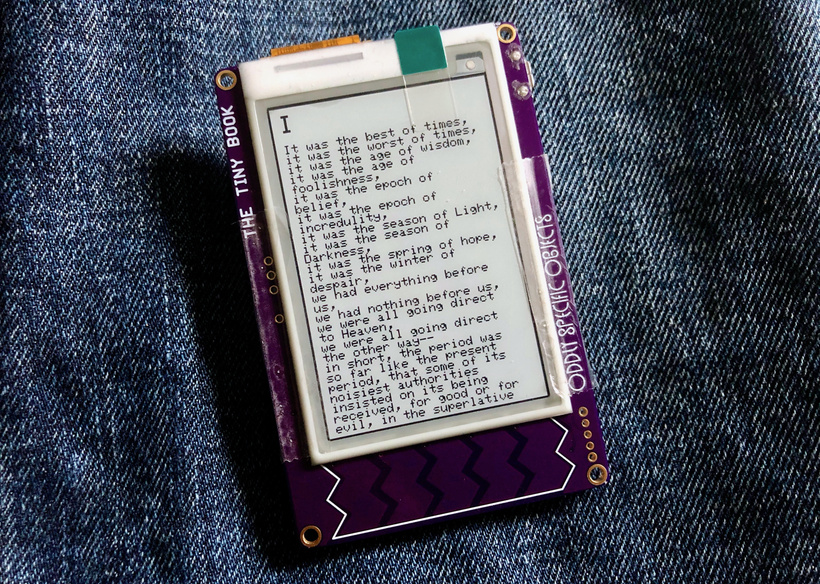
The Open Book is still the device I want to make, full stop. But late last year I was having a conversation about manufacturing with a colleague (Spencer at The Prepared; you should subscribe to his newsletter!), and it put some numbers into focus for me. To be clear, I still envision this as a device that anyone can build for themselves. But I also need to be able to make some quantity of them for people who want the gadget but don’t want to buy a soldering iron to get it.
Right now, the cost of all the parts on the board (aka the Bill of Materials, or BOM) hovers around $40 if I made 100 of them. Then you have to pay someone to manufacture the boards (cheaper in China, but possible in America). There’s also yield to worry about (a small percentage of boards may not work), and even then each working board will need a battery, and some kind of enclosure. Plus some kind of margin to cover overhead and so people can sell it. This is how his product, The Public Radio, costs $18 to make but ends up selling for $60.
All told, it made me realize that I need a lower cost option, if only as a thought experiment. So I looked at the most expensive parts and started to hack away, and ended up with this: The Tiny Book.
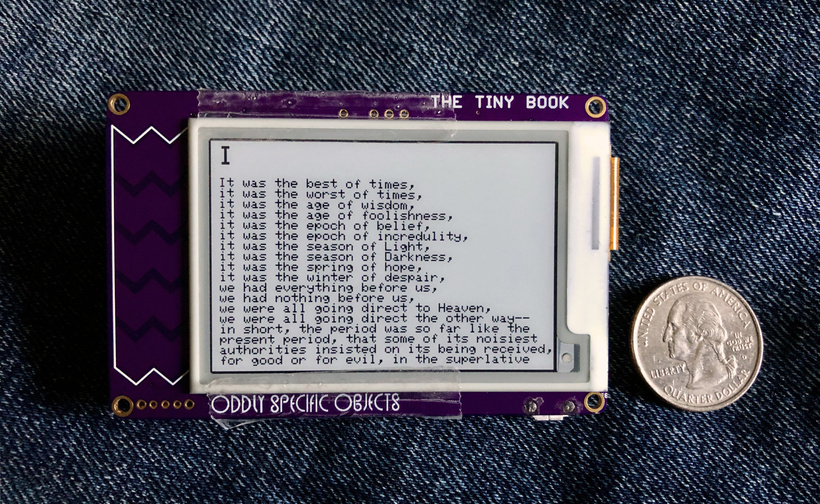
The screen is smaller (-$6.78). No more Feather headers (-$6.11). From 11 buttons to just one (-$2.94). Plus (minus) some pennies here and there. Can it work? ¯\_(ツ)_/¯
For what it’s worth, there’s some precedent for a form factor like this. Consider the Dwarsligger; these are “tiny, pocket-size, horizontal flipbacks” and they’re apparently huge in the Netherlands. Napoleon Bonaparte famously carried a tiny library along on his campaigns (where he did other famous things); and from the Middle Ages to the Victorian Era, miniature books were a popular format for everything from devotionals to etiquette guides.
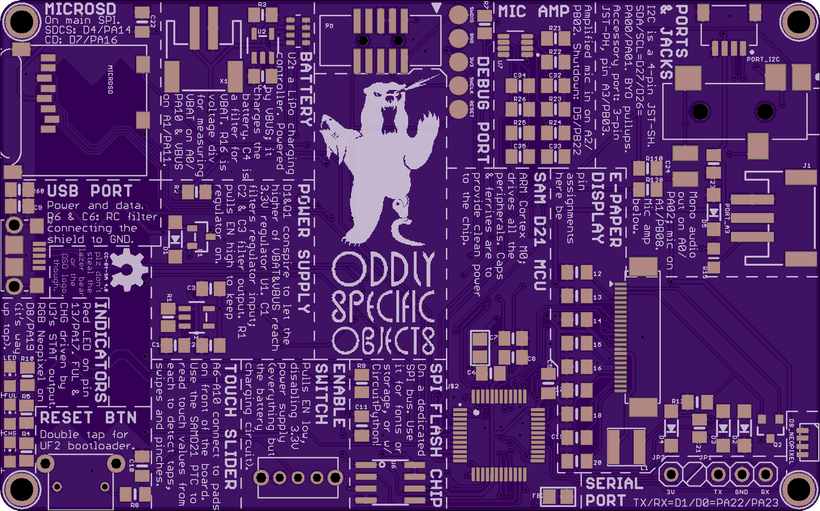
Even if it doesn’t work as a format for reading, it could end up being a really interesting hobbyist board: low power e-paper screen, a headphone jack for audio, ports for sensors or LED’s, a serial port for communicating with other gadgets, and five capacitive touch inputs in the form of a slider. You could turn it into a lot of things besides just a book, is what I mean!
It’s not real yet; the first attempt at the board had some issues. I may also end up redesigning the whole thing to accommodate a different microcontroller (or rather, the same microcontroller that’s in the Open Book). But hey! This is a thing I was hacking on over the holidays.