There’s More To It Than That
Originally published on Patreon.
There’s an old Mitch Hedberg joke: “They say the recipe for Sprite is lemon and lime. But I tried to make it at home — there’s more to it than that.” It’s relevant to today’s lesson: no matter how simple you think the thing you’re making is, you’re going to find that there’s more to it than you expect.
In the last post, I mentioned that the “why” of Sensor Watch was to learn about manufacturing by making something simpler than the Open Book. One of the first lessons I learned was that Sensor Watch wasn’t nearly as simple as I thought.
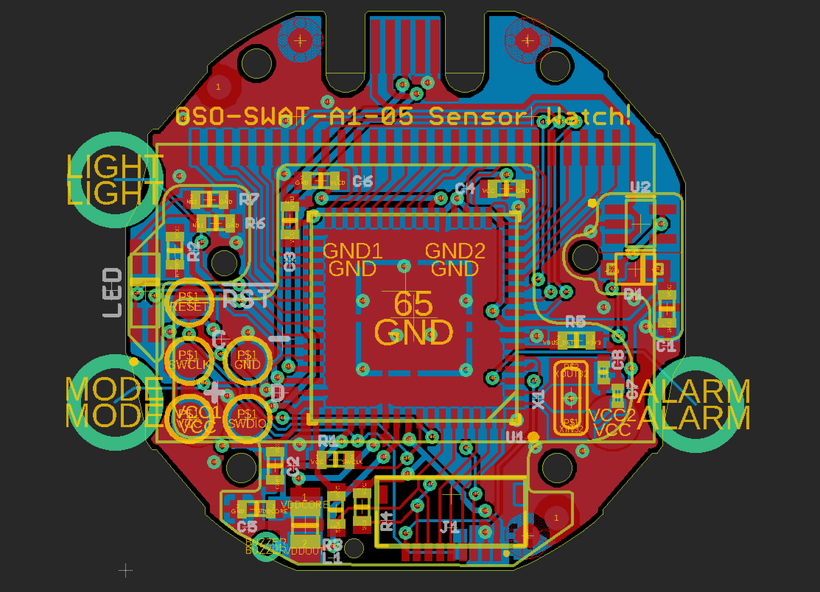
The gadget itself is fairly straightforward. I’m fond of saying that there’s really only one piece of silicon on the whole board: the SAM L22 microcontroller. There’s a crystal oscillator tied to the crystal oscillator pins, an LCD tied to some LCD pins, and an LED tied to some GPIO pins, but it’s more or less a breakout board for this microcontroller.
“How hard could it be?” That was my thought as I built the first ten boards on the table of the workshop. “If I can build ten of them here,” I thought, “surely a robot can build the next hundred for me, and after that it’s gravy: if I need 1,000 boards, the robot just has to do the same thing again and again. Right?”
Narrator: He wasn’t right.
The reality is, the processes that get you to one object can probably get you to 10, but the processes that get you to 10 won’t get you to 100. And the processes that get you to 100 will probably need some dialing in before they get you to 1000.
The Thing you’re Making vs Making your Thing
Once all the parts for the first hundred boards were on hand, I handed the job over to my manufacturing partner. Fun fact: they have a pick and place robot! Even more fun fact: a person operates that robot. His name is Chris and he’s great at his job. But when I imagined a machine spitting out panels of boards, I missed the part where there was a human in the loop.
That human factor was how we caught the issue I mentioned in the last post, the board flex in the big panels. You can see it in that “behind the scenes” video above: 59 seconds in, the robot drops the microcontroller into place, and the whole panel bends. That’s because at 0.6 mm, the fiberglass circuit boards for Sensor Watch are thinner than most boards. This makes them less rigid. Chris caught this, and suggested we break the panels in half to improve yield.
After a year of work on this thing I was making, I had no idea that making this thing would involve changing the panel layout.
Anyway: we made the first hundred boards, and I discovered a few failures. That’s to be expected; no manufacturing process yields 100%. But by the time we made the next 400, some trends started to emerge. On some boards, the real-time clock wouldn’t tick. On others, either the red or the green LED would fail. And on some boards, the whole thing had a short circuit.
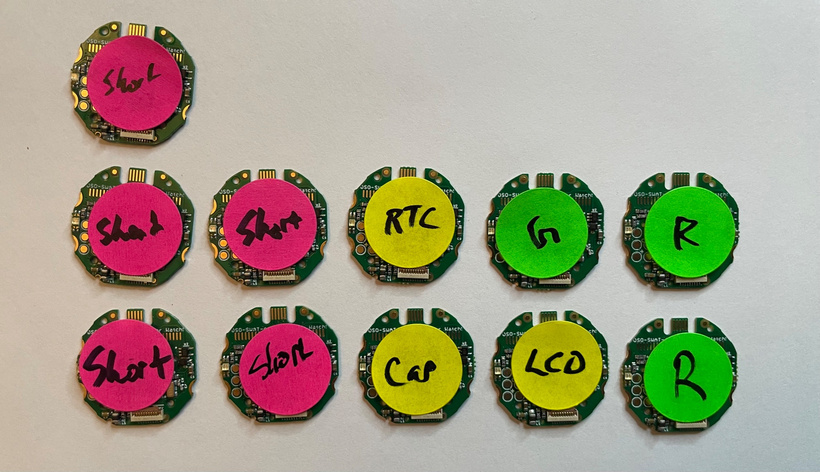
These failures each got color coded stickers, and after I was done shipping the boards that worked, I investigated the boards that didn’t. The findings:
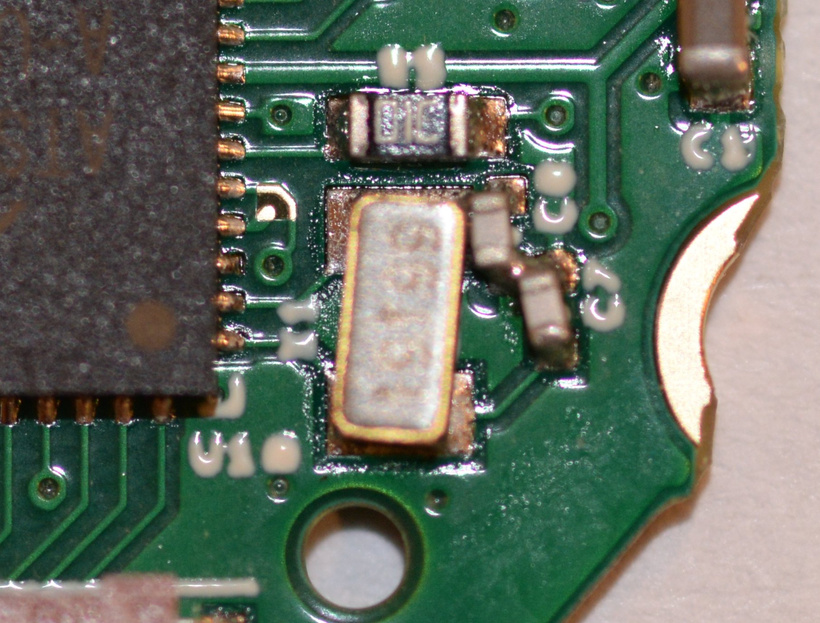
When the clock failed to tick, it was invariably because one of the tiny 0402 capacitors by the crystal had reflowed improperly.
When the LEDs failed, it was because one of the current limiting resistors had failed to get enough solder paste.
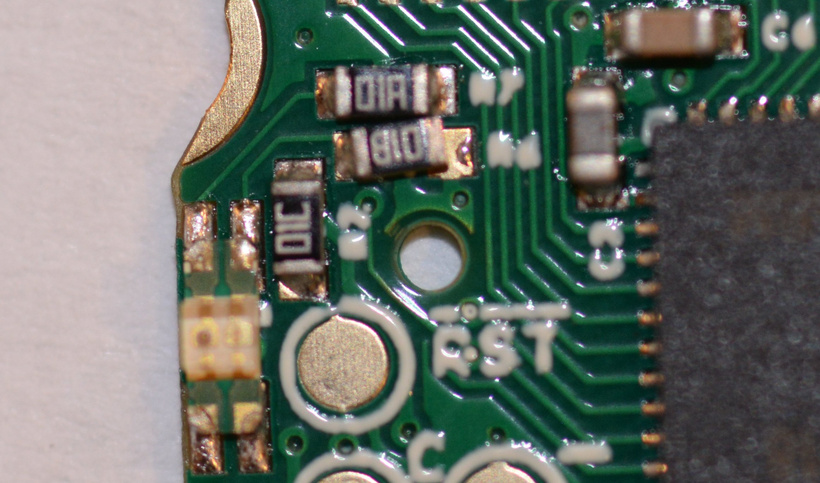
When the board was short circuited, it was almost always because of a short on the far left or far right side of the panel (this is the short at the far right).
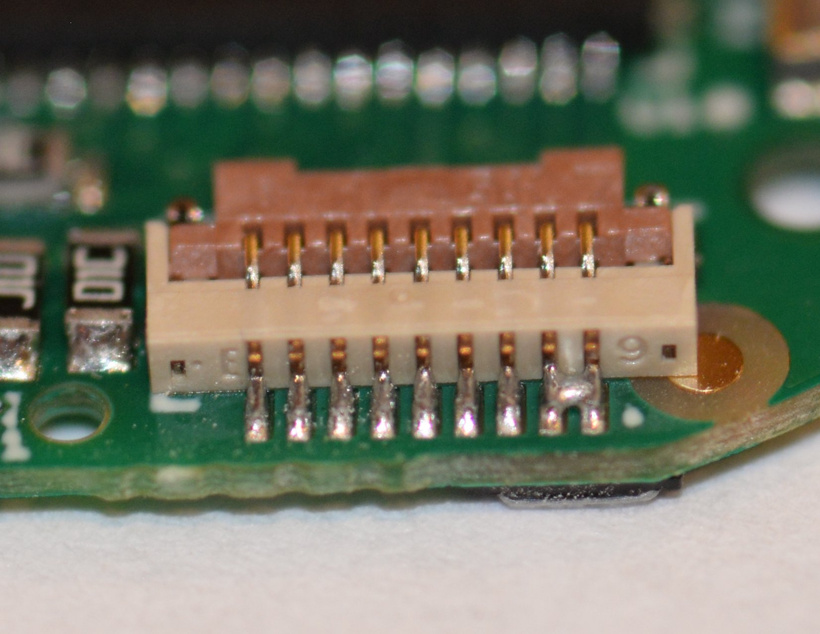
Armed with these notes, I talked to my manufacturer. We identified root causes and came up with strategies to mitigate them:
- The capacitor failure was my fault: I designed the board with the 0402 capacitor too close to the crystal.
- To address this, Chris had the robot place that part a little further to the right, dropping it so it was less likely to shift when reflowed.
- The LEDs weren’t getting enough paste because the board was flexing when solder paste was applied.
- My manufacturer addressed this by adding more supports under the board when applying solder paste.
- The shorts on the left and right happened because the solder paste smeared due to the lack of support on the sides of the panel.
- Rails on the left and right of the panel would improve this, but in the meantime, supports in those spots improved the yield dramatically.
Bottom line: no matter how much I thought I knew about the thing I was making, these are all things that I needed to know to successfully make the thing at a larger scale.
Lessons Learned
Looking back, I thought I was making something simpler than the Open Book. And in terms of raw part count, I was! In this case, though, the complexity came from other places. I had designed an unusually small board, packing components close together on thinner fiberglass than usual, and with tolerances that were much tighter than the average breakout board.
Looking forward, I see the designs I’m working on now and I’m noticing places where I can make making the thing easier: using more traditional board thicknesses for example, or having more respect for component courtyards. I’m doing this because I know that once I’ve made the first ten and it’s time to make the next hundred, I’m going to discover that there’s more to them too.